Have you ever known exactly what you should do when you're upset… and then proceeded to do absolutely none of those things?
Welcome to being human.
This is where DBT, or Dialectical Behaviour Therapy, can be helpful.
Despite its complicated-sounding name, DBT is actually pretty practical. It teaches skills for handling strong emotions, getting through stressful situations, communicating with other people, and generally dealing with life when your brain decides that everything is suddenly A Very Big Deal
So… What Exactly Is DBT?
DBT is a type of therapy originally developed by psychologist Dr. Marsha Linehan.
The word dialectical basically means that two things that seem opposite can both be true.
For example:
“I'm doing the best I can.”
AND
“There are things I can work on.”
Both can be true at the same time.
DBT combines acceptance with change. Instead of telling yourself, “I shouldn't feel this way,” DBT helps you recognize what you're feeling while also asking:
“Okay. What can I do next?”
And thankfully, DBT gives us actual skills for answering that question.
The Four Main DBT Skills:
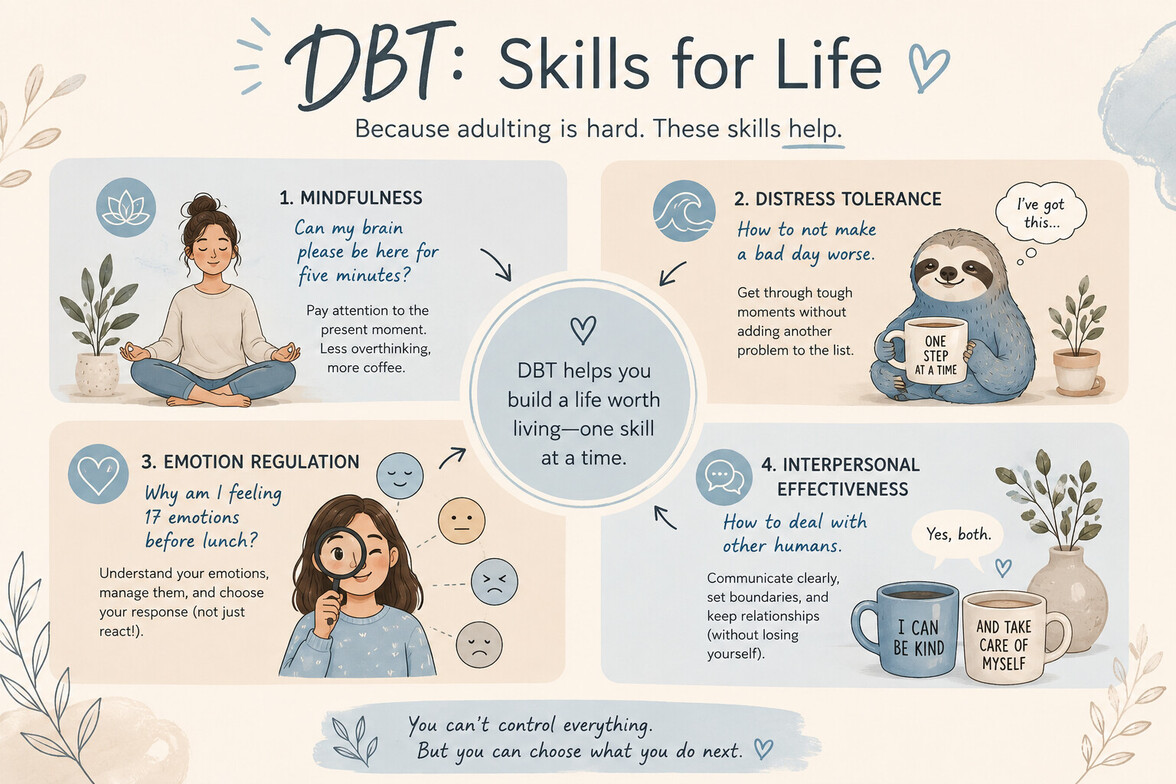
1. Mindfulness — AKA “Can My Brain Please Be Here for Five Minutes?”
Mindfulness is about paying attention to what is happening right now instead of getting lost in everything that happened yesterday or might happen tomorrow.
Your brain:
“Remember that awkward thing you said three years ago?”
Mindfulness:
“Yes. Anyway, we're making coffee right now.”
The goal isn't to stop thinking. It's learning to notice your thoughts without automatically following every single one of them down a rabbit hole.
2. Distress Tolerance — AKA “How to Not Make a Bad Day Worse”
Sometimes things are awful, annoying, stressful, or completely outside of our control.
Distress tolerance is about getting through those moments without doing something that creates an even bigger problem.
Bad moment:
“Everything is terrible.”
Brain:
“Should we send a dramatic text?”
DBT:
“Perhaps we wait.”
Sometimes success isn't fixing the situation. Sometimes success is simply surviving the moment without adding another problem to tomorrow's schedule.
3. Emotion Regulation — AKA “Why Am I Feeling 17 Emotions Before Lunch?”
Emotion regulation helps us understand what we're feeling, why we're feeling it, and what we want to do about it.
Because emotions sometimes have a slightly dramatic interpretation of events:
Someone doesn't reply for 20 minutes.
Brain:
“They hate us.”
Reality:
They're probably in the shower.
DBT helps us slow things down, check the facts, understand our emotions, and choose how we respond instead of letting an emotion immediately take control.
4. Interpersonal Effectiveness — AKA “How to Deal With Other Humans”
Unfortunately, DBT has not yet discovered a way to make everyone communicate perfectly.
So instead, interpersonal effectiveness teaches us how to communicate more clearly.
That includes asking for what you need, saying no, setting boundaries, handling disagreements, and maintaining relationships while still respecting yourself.
Instead of:
“It's FINE.”
Narrator: It was absolutely not fine.
DBT helps us actually communicate what we mean.
Basically, interpersonal effectiveness is learning how to deal with other humans without expecting them to magically read your mind.
Do You Have to Be in Crisis to Learn DBT?
No.
DBT skills can be useful for many people who want to better understand their emotions, communicate more effectively, cope with stress, or respond differently when things become overwhelming.
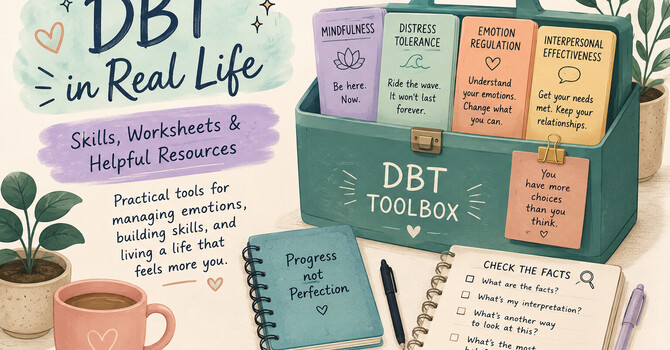
Think of DBT skills like tools in a toolbox.
You probably don't need every tool every day.
But when something breaks, it's nice to have more than a butter knife available.
The Simplest Way to Think About DBT
If you forget everything else in this article, remember this:
DBT teaches you how to notice what you're feeling, tolerate difficult moments, manage emotions, and communicate effectively.
You can't control everything that happens.
You can't control every thought that appears.
You can't control what other people do.
But you can practice choosing what you do next.
And sometimes that's the whole point.
_______________________________________________________________________________________________________
This article is for general educational purposes and isn't a substitute for individualized mental-health care.

Diana Rochester
Contact Me